
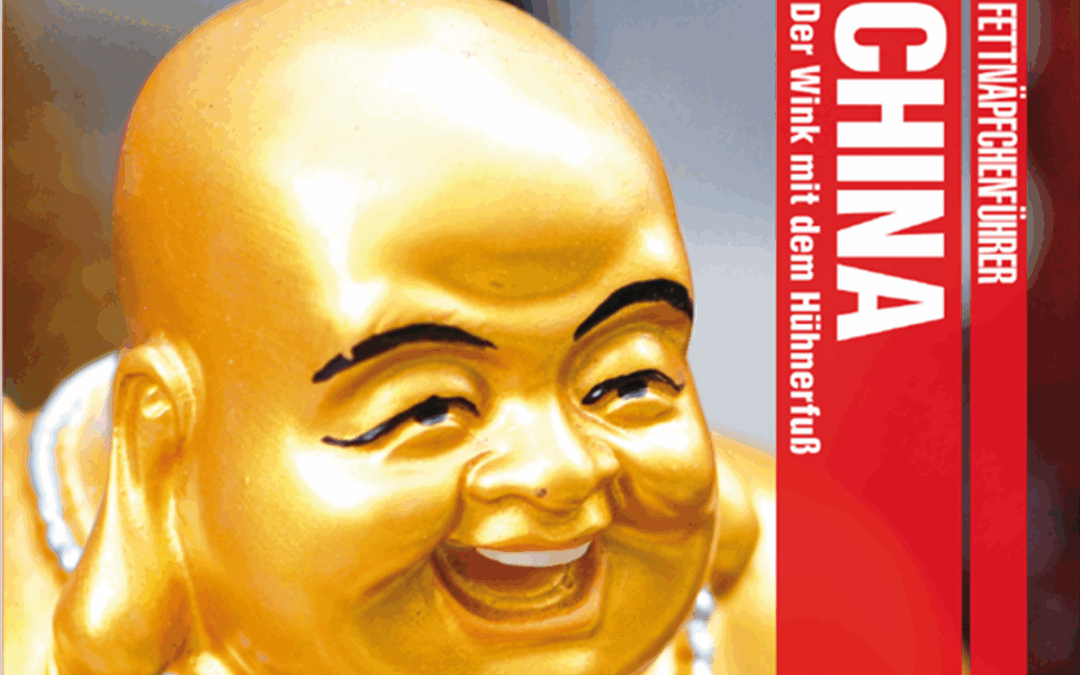
Book Summary
Anja Obst: China – The Hint with the Chicken Foot
Context and Core Idea of the Book
China – The Hint with the Chicken Foot is an intercultural narrative that highlights cultural differences between China and the Western world—particularly Germany. The story centers on a German student, Peter Auer, who spends six months in Beijing to study and complete an internship. Step by step, he experiences everyday life in China—and repeatedly finds himself in awkward cultural situations.
The book combines personal experiences with factual background information. Each episode begins with a Chinese proverb (chéngyǔ), which serves as a thematic guide for the chapter. The story does not follow a dramatic plot; instead, it focuses on everyday life. This is precisely where its strength lies: it demonstrates that intercultural misunderstandings are rarely spectacular, yet they can have lasting effects.
Arriving in a Different World
The prologue already makes it clear that cultural differences often appear in seemingly trivial situations. A simple glass of water—hot in China, cold and sparkling in Germany—becomes a symbol of different habits, ways of thinking, and assumptions about what is normal. The author shows that anyone traveling to another country must be prepared for even ordinary things to suddenly feel unfamiliar.
Peter experiences this immediately upon arriving in Beijing. Even the greeting at the airport presents his first challenges: business cards are exchanged with both hands, names follow different conventions (family name first), and titles play an important role. While Peter initially perceives many of these gestures as insignificant from a German perspective, they carry strong social meaning in China. Politeness and respect are communicated not only through words but also through ritualized forms of behavior.
This becomes particularly clear when discussing names. In China, names carry symbolic meanings and reflect the hopes parents have for their children. A name is not merely an identifier but also a promise for the future. Even social developments such as the one-child policy are reflected in naming practices—for example, daughters named “Zhaodi” (“looking for a little brother”). In China, names often tell a social story.
Curiosity as a Cultural Phenomenon
A central theme of the book is the direct curiosity many Chinese people show. Peter is repeatedly confronted with questions that would be considered intrusive in Germany: How old are you? Are you married? How much do you earn? What do your parents earn?
While Peter initially reacts with irritation, the author explains the cultural background. For a long time, China was relatively isolated from the outside world; encounters with foreigners were rare or politically restricted. Even today, meeting someone from another country is still something special for many people—particularly outside major cities. Questions are therefore not intended to cross personal boundaries but to understand and categorize the other person: Who are you? How do you live? How is your life different from mine?
This illustrates that privacy is defined differently across cultures. In Western societies, financial questions are often considered taboo, whereas in China they can be part of normal information exchange. Income is less associated with personal status and more with comparison and orientation. The Western emphasis on privacy can sometimes appear distant—or even suspicious—from a Chinese perspective.
Improvisation and Inventiveness
Another defining experience for Peter involves the heating system in his dormitory. Instead of replacing the defective unit, technicians attempt to repair it using improvised solutions—chopsticks, coins, and wire. To Peter, this initially appears unprofessional and almost absurd.
However, the book again provides important context. Decades of economic scarcity in China created a culture of improvisation. Nothing is thrown away; everything is repaired, adapted, or repurposed. Creativity grows out of scarcity. Even though many goods are now widely available, this mindset still shapes generations.
At the same time, the author reminds readers of China’s major historical inventions: paper, printing technology, gunpowder, and the compass—as well as porcelain, seismographs, and paper money. The seemingly improvised solutions of the present exist within a long tradition of technological ingenuity.
Food as a Social and Cultural Stage
Food plays a particularly prominent role in the book. Peter’s first restaurant visit becomes a cultural shock: loud conversations, bright lighting, bones on the floor, shared dishes, and rice served at the end of the meal. In Germany, shared meals are often “experience-oriented”—with a focus on conversation, atmosphere, and table culture. In China, they are often more “result-oriented,” focusing on taste, variety, and quantity.
Several differences become clear:
- Dishes are ordered for the whole table and placed in the center.
- Rice is served at the end as a filling staple.
- Finishing all the food suggests that there was not enough.
- Bills are not split; guests are not expected to pay.
Table manners also differ significantly. Slurping, burping, or placing bones on the table may not be considered impolite. Hygiene is understood pragmatically—concrete floors are easier to clean than carpets. What may appear disrespectful to Western visitors often has practical reasoning in the Chinese context.
At the same time, the book shows that meals are about much more than food. They express care, generosity, and social status. Ordering too little may appear stingy, while offering the best pieces to guests demonstrates appreciation.
Language as a Key—and a Challenge
The Chinese language, with its tones, characters, and idiomatic expressions, presents a particular challenge for Peter. Misunderstandings arise not only from incorrect words but also from culturally embedded meanings.
The chapter titles—Chinese chéngyǔ—demonstrate how strongly metaphors shape thinking. Four characters are enough to convey complex stories or moral messages. Language is therefore not only a communication tool but also a form of cultural memory.
In everyday life, language is also used strategically—for example when expressing criticism or frustration. Directness, which is common in Germany, can lead to a loss of face in China. Conversely, indirect communication may appear evasive or unclear to Westerners.
Traffic, Bureaucracy, and Apparent Chaos
Peter experiences Beijing as a city in constant motion. Traffic seems chaotic, and rules appear to be interpreted flexibly. Yet even here, what looks like disorder often follows informal patterns.
The same applies to bureaucratic procedures—for example when opening a bank account. Forms, stamps, waiting times, and seemingly unnecessary formalities may appear inefficient from a Western perspective. However, they are part of a system that creates security through ritual and structure.
Family, Relationships, and Society
The book also explores topics such as wedding traditions, matchmaking in public parks, the one-child policy, and the relationship between urban and rural life. These examples highlight the strong role families play as social safety networks. Children are expected to take responsibility for their parents, and sons have traditionally been considered a form of old-age security.
Relationships are understood less individualistically than in many Western societies. Marriage is not only a romantic partnership but also a social alliance. Partner selection is often influenced by family expectations and societal norms.
Negotiation and “Saving Face”
Several episodes focus on business negotiations, including banquets, drinking rituals, and karaoke. These situations reveal a different logic from many Western business environments. Relationship building often takes precedence over factual arguments. Trust develops through shared experiences—eating, drinking, and spending time together.
“Face”—meaning social reputation and dignity—plays a crucial role. Open confrontation is usually avoided, and criticism is expressed indirectly. Public embarrassment can lead not only to a loss of status but also to a loss of influence.
Learning and Shifting Perspectives
Over time, Peter’s perspective begins to change. Initial irritation turns into curiosity, and rejection gradually becomes understanding. He learns not to judge differences immediately but to explore their meaning.
The prologue already hints at this perspective. The author herself lives between cultures and combines habits from both worlds: cold mineral water, tablecloths, and candles from Germany; hot tea and lively conversations from China. Culture is not a rigid system but a space that can be shaped and combined.
Key Messages of the Book
- Cultural differences are normal—they are neither better nor worse.
- Misunderstandings often arise from assumptions we take for granted.
- Curiosity, openness, and humor make integration easier.
- Behind every behavior are historical and social influences.
- Intercultural competence requires perspective-taking.
Conclusion
China – The Hint with the Chicken Foot is more than a travel narrative. It is an invitation to understand cultural differences rather than judge them too quickly. By combining storytelling with contextual explanation, the author succeeds in making complex social dynamics accessible and vivid.
The book demonstrates that intercultural competence does not emerge from factual knowledge alone. It develops through the willingness to question one’s own assumptions. Peter’s six months in Beijing become a learning journey—not only through China, but also through different ways of thinking.
Readers ultimately recognize that the “hint with the chicken foot” is not meant as mockery. It is a friendly reminder that different cultures follow different rules—and that learning these rules reveals not only something about another country, but also about ourselves.
Recent Comments