
Birgit Fischer-Sitzwohl | Strategies and Tools for Clear Aims and Effective Teamwork
German Edition: Schäffer-Poeschel Verlag, Stuttgart, 1st edition, 2026, 168 pages
English Edition: via Amazon Selfpublishing
Structure as the Foundation of Effective Collaboration
Many challenges in organizations arise not from a lack of motivation or expertise, but from unclear assignments, differing views of the desired outcome, and acting too quickly. These are precisely the challenges Birgit Fischer-Sitzwohl addresses in her management book, Collaboration with a System (Zusammenarbeit mit System). Its central message is that effective collaboration does not happen by chance. It can be deliberately improved through a shared way of thinking and working. The book shows how teams and individuals can create clarity, assign responsibility appropriately, structure their work, and learn from experience.
The book’s practical focus reflects the author’s extensive professional experience. Fischer-Sitzwohl has worked as a consultant and trainer with Coverdale since 2001, applying the Coverdale method in a wide range of consulting and training settings. She has been Managing Partner of Coverdale Austria since 2007.
Her experience in leadership and organizational development, mediation, conflict management, and international collaboration informs the entire book. Rather than explaining the tools in the abstract, she illustrates them through familiar situations from leadership, project work, and day-to-day business.
Seven Steps from Clarifying the Task to Reviewing the Experience
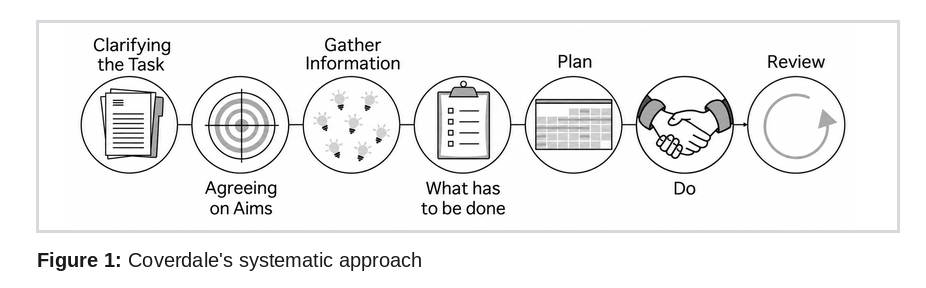
At the heart of the book is Coverdale’s systematic approach. It consists of seven steps: clarifying the task, agreeing on aims, gathering information, identifying what needs to be done, planning, doing, and reviewing.
This sequence helps teams avoid jumping straight to solutions or assigning tasks too early, while also preventing them from spending too long in discussion and analysis. Importantly, the method is not intended as a rigid process model. In complex initiatives, individual steps can be revisited and repeated in short, iterative cycles.
Four thinking tools translate this systematic approach into practical ways of working. Their value, however, lies not in filling out a particular template but in the principles behind them:
- Create clarity first.
- Keep information and tasks separate.
- Make responsibilities visible.
- Learn deliberately through reflection.
- Combine clear direction with individual accountability.
Because these principles apply regardless of industry, level of seniority, or type of task, the tools can be used in a wide variety of situations.
An Overview of the Four Thinking Tools
| The Coverdale Aims Grid | The Planning Grid |
| The Review | The Delegation Funnel |
Figures: Fischer-Sitzwohl (2026)
From Principles to Practical Application
The book’s consistent emphasis on practice is especially evident in four recurring roles, each represented by a different persona. They reflect:
- Strategic corporate leadership
- Middle management
- Project leadership without formal authority
- Individual self-management
These roles provide a common thread throughout the book. The challenges each persona faces show how the same principles and thinking tools can be given different emphasis and combined in different ways depending on the context.
At the strategic level, the Aims Grid and result reviews help establish a shared understanding across departments. In team leadership, reviews and the Delegation Funnel are particularly useful for managing change as a gradual learning process and assigning responsibility appropriately. In project leadership, the Aims Grid, Planning Grid, and brief reviews create clarity and commitment even without formal authority over team members. For individual self-management, the same tools help clarify client assignments, set priorities, and systematically reflect on experience.
The case studies later in the book explore these applications in greater depth. They show not just how to use an individual tool at a particular moment, but the entire journey from the initial situation through aim-setting, planning, and implementation to review.
This demonstrates how individual thinking tools become a consistent way of working. The cases differ in role and challenge, but they rest on the same principles. It is precisely this combination of a consistent underlying approach and flexible application that makes the Coverdale method relevant to a wide range of work situations.
Principles, Not Recipes
The Coverdale method operates at the level of principles. The Aims Grid, Planning Grid, Review, and Delegation Funnel are therefore not rigid forms to complete but practical tools for thinking. They share a common logic: clarity before action, attention to stakeholders, transparent planning, clear responsibilities, and learning from experience. These principles remain constant, while their application is adapted to the situation, the role, and the complexity of the task.
A Distinctly Practical Approach
Collaboration with a System works well as both a practical guide and a hands-on workbook. Its clear language, recurring scenarios, and many guiding questions make it easy to get started and apply the ideas to one’s own work.
The connection between clarifying aims, planning, and reflection is particularly effective: the tools do not stand alone but work together as part of a systematic approach. The distinction between result reviews and process reviews is also valuable, as it takes into account both the quality of the outcomes and the way the team works together.
The book’s particular strength is its role as a well-grounded practical guide. Principles tested over many years are translated into accessible tools and concrete questions that readers can put to work immediately in leadership, project management, teamwork, and individual self-management.
The result is a book that offers more than guidance: it helps readers make collaboration more effective, one step at a time.
Value in Day-to-Day Professional Practice
This practical guide is especially useful for leaders, project managers, internal consultants, and self-employed professionals who want to take a more deliberate approach to collaboration.
Its greatest value comes from putting the ideas into practice right away. One real initiative is enough to get started: first clarify the task, then answer the four questions in the Aims Grid, make information and tasks visible in the Planning Grid, and conduct a brief review after the next milestone.
This makes the central idea tangible: structure does not take freedom out of collaboration. It creates the conditions in which responsibility, learning, and collective effectiveness can thrive.
Recent Comments